Technology as a Support for People with Specific Needs
Generally speaking (most of us, at least), we take for granted that we can do anything because our body is healthy and complete, and so we function normally; and that’s probably true. However, we also don’t know whether tomorrow things will stay the same or something important will change our circumstances and wake us up to a different reality. Thousands of people around the world live this different reality, and although we may never experience it firsthand, it’s important not to see it as something foreign, since the future is, above all, uncertain. This population has very specific needs, and although they’re usually independent thanks to their ability to adapt, they also need some support (however small) to carry out the activities that make up the most basic parts of daily life, such as interacting with others, reading, using public transportation, eating, going to school or work, or simply listening.

Generally speaking (most of us, at least), we take for granted that we can do anything because our body is healthy, complete, and so we function normally; and that’s probably true. However, we also don’t know whether tomorrow things will stay the same or something important will change our circumstances and wake us up to a different reality. Thousands of people around the world live this different reality, and although we may never experience it “firsthand,” it’s important not to see it as something foreign, since the future is, above all, uncertain.
This population has very specific needs, and although they’re usually independent thanks to their ability to adapt, they also need some support (however small) to carry out the activities that make up the most basic parts of daily life, such as interacting with others, reading, using public transportation, eating, going to school or work, or simply listening.
Fortunately, these people are now supported by various government and non-government organizations, as well as by individuals who have become aware of the situation, but clearly they can’t reach everyone who needs help. That’s why we find volunteers in care homes; people who generously share their experience and knowledge with people with learning difficulties; organizations that run awareness workshops; real-time LSM (Mexican Sign Language) interpreters for people with hearing impairments; training courses for specific groups… But there’s still a lot to do.
And what if we could use technology to make things easier for them?
Of course we can! And although the idea isn’t new, there’s still a lot of room to make the most of it. In fact, there are already many technology initiatives aimed at this kind of support, led by people who not only have the knowledge, skills and desire to contribute, but also the vision and determination to act.
One example is an interesting biomedical engineering project by Carolina Tejeda, a graduate of CETYS Universidad (Centro de Enseñanza Técnica y Superior) and part of Soblin, a company that has developed the first bionic leg prosthesis in northwestern Mexico. With their own technology (Mexican, too), Tejeda and her colleagues developed bionic prostheses for the lower limbs and successfully presented their project at the Hannover industrial fair in Germany. This young team specializes in designing and building prostheses using advanced IoT (Internet of Things) and mechatronics technologies.
Meanwhile, bionics engineer Luis Armando Bravo, a graduate of the IPN (Instituto Politécnico Nacional) and founder of Probionics, also developed innovative, affordable bionic prostheses backed by 5 international patents. These prostheses are controlled by the user’s electrical impulses, giving them more control, better adaptation and a much better quality of life.
Likewise, Cristhian Prieto, Erick Pérez and colleagues, mechatronics students and engineers from the UAM (Universidad Autónoma Metropolitana), the UNAM (Universidad Nacional Autónoma de México) and the ITEM (Instituto Tecnológico de México), and founders of Microprots (still in its early stage), developed bionic prostheses and rehabilitation software assisted by virtual reality. The idea came from researching the types of disability in Mexico, where motor disability is the most common, at 67% nationwide. Their proposal combines a bionic prosthesis with software they developed themselves, including mixed reality simulators, for comprehensive rehabilitation. The prostheses have myoelectric control systems (conscious control of the prosthesis) and biomechanical systems (spatial positioning that gives the prosthesis reflexes).
What about apps?
In the specific field of apps, there are many examples around the world, too.
To start with, the University of Granada in Spain, through its GEDES research group, developed an app called PICAA 2, aimed mainly at people with pervasive developmental disorders (PDD), particularly autism spectrum disorder (ASD), and Down syndrome. The app helps improve communication with their surroundings, as well as memory or cause-and-effect learning, depending on the case.
There’s also the Braille Teacher app (based on the Spanish Braille alphabet), created by Comm CISO, which converts Braille into a human voice, making it simple and practical to learn the system. Thanks to it, anyone can learn Braille, teach people who are blind or have low vision, and interact with them.
Also supporting this community, there’s another app tested and endorsed by the ONCE Foundation: Lazzus. Developed in Asturias, it works as a personal assistant that supports the independence and mobility of blind people by creating an “auditory field of vision,” providing relevant information about the user’s surroundings, for example, whether there’s a crosswalk or stairs nearby. It’s now available for iOS and Android.
Di-Capacitados, a Spanish company that supports people with some kind of functional diversity, developed the Voicebook app, an interesting tool designed for people who have difficulty moving their hands due to conditions such as multiple sclerosis, venous thrombosis or stroke. This e-book reader lets them read without touching the screen, since it can be controlled with voice commands, whether to choose a book, turn the page or even add bookmarks.
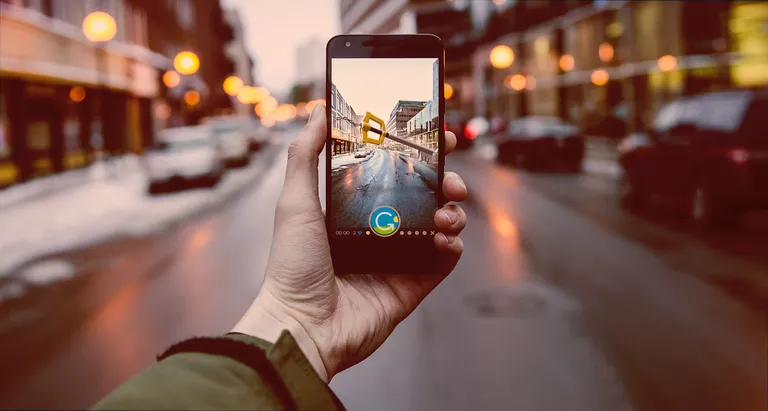
Big companies like Google have also joined the cause, doing their part to support people with specific needs. One example is the well-known Google Maps. Among its updates, it has added “wheelchair accessible” routes for people with reduced mobility. When you set your directions, in the “Options” you can choose “less walking,” “fewer transfers” or “wheelchair accessible,” and the results take accessible stations into account. Also, thanks to Street View images, users with specific mobility needs can check the area ahead of time and assess the risks or accessibility. This has been possible thanks to contributions from users through Local Guides. Accessible routes are already available in Mexico City.
As you’ve probably noticed, new technologies don’t just make our lives more convenient and optimize our processes by cutting down travel time (for example, to make bank deposits or do some shopping). They can also help us improve many aspects of daily life and, above all, be great allies in supporting people who otherwise might not have had the chance to improve their quality of life.
Let’s join the cause! Let’s be part of the difference!
Do you have an idea in mind?
We’d love to hear it so we can work with you and help you make it a reality. Get a quote for that big project you have coming up!
Itzia Valdez
More articles by Itzia