B2B SaaS
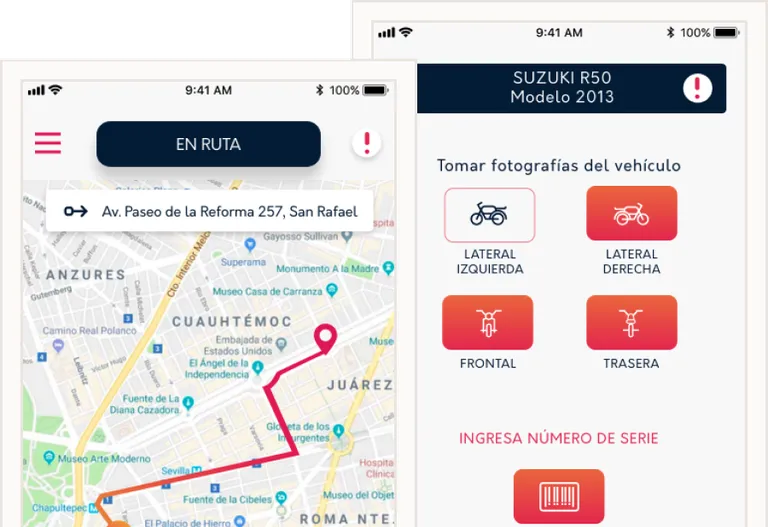
Datar
A B2B platform cross-checking public and private sources to validate policies, fleets and operations for its insurance clients.
- +42%
- Cancellations avoided
- -70%
- Reporting time
- 16
- Integrations

PXL INTELLIGENCE
Most requested
We design predictive models, intelligent agents, internal assistants and solutions based on artificial intelligence that improve decisions, produce actionable predictions and unlock measurable competitive advantage.
What's included
Internal and external assistants integrated with your documentation, CRMs, ERPs and knowledge bases. Controlled access and traceability by role.
We forecast sales, demand, inventory or customer churn with models trained on your historical data. Predictions that beat fixed rules and adjust as your operation changes.
OpenAI, Anthropic, open source models on your own infrastructure, and vertical models. We recommend based on use case, cost and data privacy.
We connect AI with documents, PDFs, databases and internal systems for contextual answers with verifiable citations.
Where the case justifies it, we train models on your proprietary data to reduce hallucination and improve vertical accuracy.
Advanced OCR and document classification models (invoices, contracts, forms) using ML/NLP. High accuracy, cross-validation and handling of edge cases. The operational pipeline around the model (where the document enters, where it is routed) is covered by PXL Automation.
Deployment and versioning of models and prompts, monitoring of accuracy, bias and hallucinations, and control of token and compute costs. Without observability, AI is a black box.
We define the usage policy, access control for sensitive information and training for the team. Badly governed AI is a regulatory and reputational risk.
Voice and chat assistants built with Amazon Connect's agentic CX designer (Amazon CX Designer), connected to your systems. With Live Sync they guide users inside your app or website during the call.
Interfaces built in real time from what the user asks in natural language, instead of fixed menus and forms. Connected to your data, with controls so each role sees only what it should.
Who it's for
We'll help you decide quickly. If we are not the right match, we point you to who is.
Problem
Many companies are integrating AI purely as a marketing trend. The result is models disconnected from the business, agents that hallucinate and products that generate more noise than value. Badly implemented AI does not merely fail to solve problems, it multiplies them: wrong answers reaching customers, automation that breaks critical processes, and projects that die 6 months after the pilot.
Models answering with incorrect or out-of-date information (hallucinations)
Agents that do not understand context and produce useless generic answers
Risks of exposing sensitive data through poor RAG architecture
Uncontrolled token costs with no observability and no limits
Brilliant pilots in demos that never reach production
Teams abandoning the tool because it was never integrated into their real workflow
Outcomes
The difference is not using AI, it is using it where human judgement arrives late or goes astray. AI implemented well shows up in concrete business outcomes: sales closing with instant information, predictions that beat fixed rules, agents answering with verifiable context, and teams that stop improvising decisions.
A measurable reduction in human error on decisions that used to depend on intuition or individual experience
Faster answers to internal and external customers with verifiable context
Expert judgement scaled across the team (the model replicates what only the most senior person knew how to do)
Real competitive advantage over competitors who are barely implementing FAQs
Proprietary data turned into strategic company assets
Decisions taken on information synthesised in seconds, not hours
Process
We identify cases where AI creates real advantage (not merely where it automates): decisions that today depend on a senior expert, high-volume content that requires judgement, or predictions that beat fixed rules. We prioritise 1 to 3 initiatives with measurable impact.
Design of the AI stack, data sources, embeddings, vector store, the models to use and the RAG architecture. Definition of operational rules and observability.
Building a functional prototype with real data. Evaluation of accuracy, latency, cost and experience with pilot users.
Integration into internal systems, access controls, continuous monitoring, token observability and a continuous improvement plan.
Training for the team, a usage policy, success metrics and an evolution plan. Iteration based on real usage, not assumptions.
Related case studies
B2B SaaS
A B2B platform cross-checking public and private sources to validate policies, fleets and operations for its insurance clients.
B2B SaaS
A RAG agent for 800+ employees with access to corporate documentation, procedures and operational data. Traceability and role control.
B2B SaaS
An AI model for extracting and classifying shopping-centre operational documents (contracts, reports, invoicing). A vector database with semantic search, cross-validation and handover to a human in exceptional cases.
Stack | Tools | Standards
AI with proven models, frameworks and observability.
Frequently asked questions
AI amplifies human judgement and automates decisions that previously required an expert.
Yes, we build agents and assistants with RAG connected to your internal systems and data, not isolated demos.
Yes. We design and build customer service agents on Amazon Connect with its agentic CX designer (Amazon CX Designer) and connect them to your systems, mobile app and website, including Live Sync experiences that guide users inside the app during the conversation.
We work with different providers depending on the case: OpenAI, Anthropic, and open-source models, among others. We choose the model based on each project's privacy, cost, and performance needs.
Your data and your customers' data isn't used to train third-party models. When we connect AI to your systems, we define from the design stage what information goes out, where, and under what controls, so both you and your end users are protected.
The cost depends on usage volume, model complexity, and whether we use an external provider or our own infrastructure. Those are the variables that determine price in each case.
It depends on the use case: a well-scoped internal assistant can show measurable results within weeks, while a more complex decision-making system takes more time to tune.
Related services
PXL DATA
PXL Data
Data platforms. ETLs, data warehouses, analytics and governed dashboards for deciding with evidence.
PXL CONNECT
PXL Connect
Integrations & IoT. APIs, legacy systems, hardware and synchronisation of the digital and physical ecosystem.
PXL AUTOMATION
PXL Automation
Operational orchestration. The operational flow that executes: when the input arrives, the model decides and the decision is routed into the business systems. Without PXL Automation, the model is an isolated service with no real use.
A 30-minute diagnosis of AI opportunities in your operation.